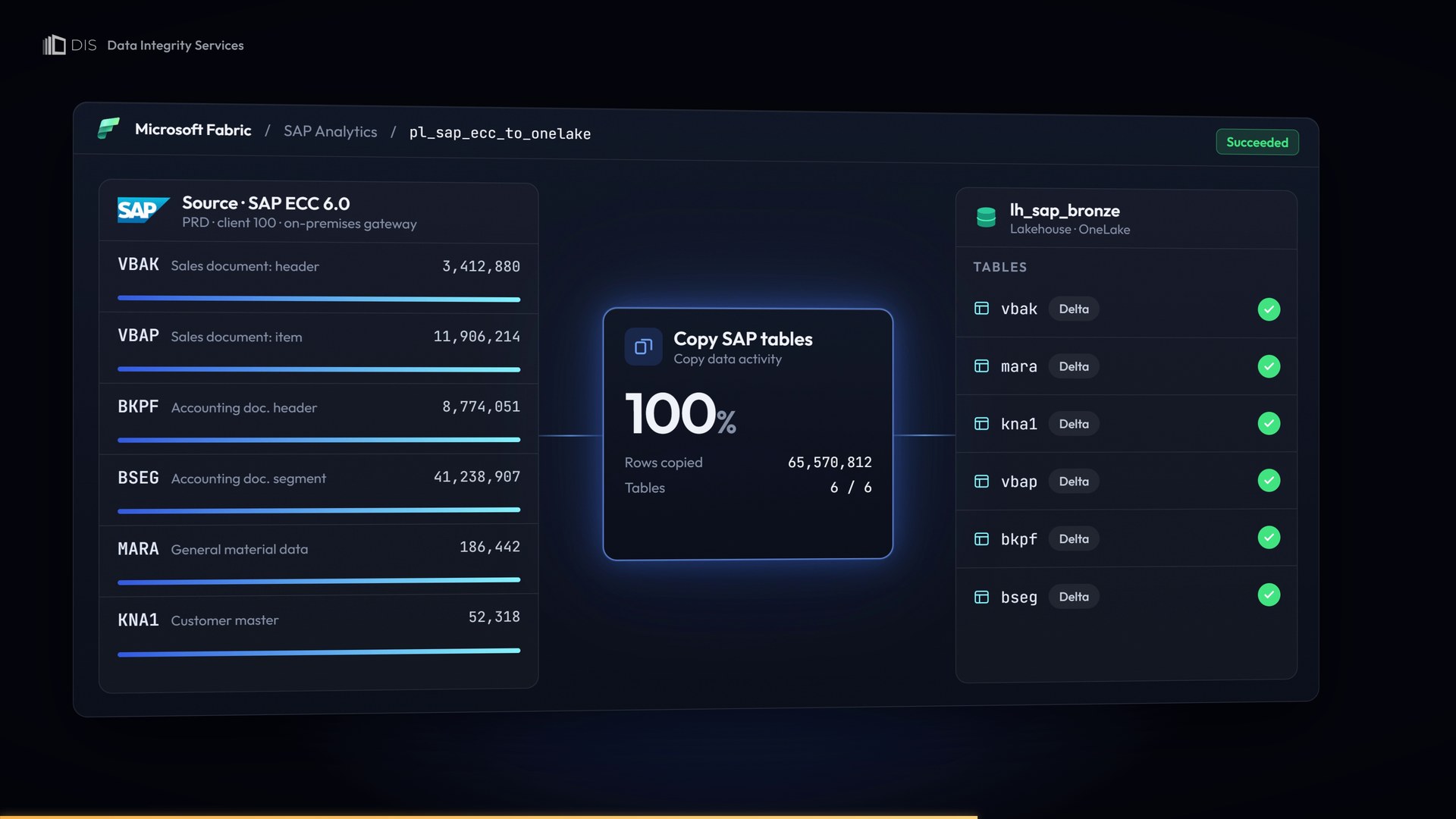
We build analytics and BI solutions on Microsoft Azure every day: pipelines, warehouses, dashboards, the full path from raw data to a decision someone can act on. Microsoft has now confirmed that work in writing, through a specialization that checks a partner's expertise against one specific scenario rather than a broad partner relationship.
What Microsoft confirmed
In a letter dated October 26, 2026, Microsoft confirmed that Data Integrity Services has satisfied the requirements for demonstrating and validating our technical capabilities in the Microsoft AI Cloud Partner Program, specifically the Analytics on Microsoft Azure specialization.
A specialization is not a general partner status. Microsoft awards it to validate deep technical expertise in one specific technical scenario, in our case, analytics on Azure. The same letter also confirms our Solutions Partner designations for Cloud & AI Platforms, under the Data and AI (Azure) and Infrastructure (Azure) pathways, current as of the letter's date.
Microsoft states the confirmation as current as of October 26, 2026, with the letter of certification valid until November 25, 2026.
Why this is the pillar we lean into
Analytics and BI on Azure is where a lot of our client work already lives: building pipelines with Azure Data Factory, modernizing warehouses with Azure Synapse Analytics, and getting a reporting layer that answers questions in seconds instead of overnight. Our data warehouse modernization case study is one example, a legacy warehouse replaced with Azure Synapse Analytics that cut data processing time by 50% across critical pipelines.
Getting a specialization is not a one-time form. It means an independent review of the team's certifications, project history and customer outcomes in that specific scenario, analytics on Azure, done by Microsoft. It is Microsoft's own check on whether the expertise behind the work is real, not a general partner relationship.
What the work actually looks like
Analytics on Azure covers the full path from source data to a decision, and that is also how we approach a project:
- Understanding the data that exists today: where it lives, who depends on it, and where the current reporting falls short.
- Solving the architecture question: which Azure services carry the pipeline, the warehouse and the semantic layer, and how they fit the business, not just the technology.
- Implementing the pipelines, the warehouse and the dashboards, and handing the team a platform they can run and extend themselves.
That is the same three-step method, Understanding, Solving, Implementing, behind every engagement we take on, analytics included.
What it means for your team
If you are evaluating a partner for an Azure analytics or BI project, this is the kind of validation worth asking any vendor for: not a general Microsoft relationship, but a specialization tied to the specific work, analytics on Azure, that your project needs. It is one factor among several, alongside references, project history and a straightforward look at your own data estate.
If your reporting is stuck on an aging warehouse, or your pipelines cannot keep pace with new data sources, see how we approach this kind of work on our services page, or tell us where your analytics stack is falling short today.